
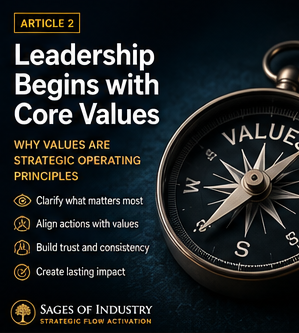
 Why Values Are Strategic Operating Principles
Executive Scenario
A founder built a successful company around a clear mission.
As the organization scaled, growth accelerated.
New leaders joined.
Processes expanded.
Priorities multiplied.
Over time, decisions became inconsistent.
Teams interpreted success differently.
Momentum slowed.
The founder believed the organization had lost focus.
In reality, it had lost alignment.
Core values had become language rather than operating principles.
Strategic Insight
Values are often treated as culture statements displayed on websites and office walls.
In high-performing organizations, values function differently.
They become decision filters.
Values determine:
- What receives attention
- How resources are allocated
- Which tradeoffs are acceptable
- How leaders behave under pressure
When leaders disconnect from their values, execution friction increases.
People become uncertain.
Decision-making slows.
Conflicting priorities emerge.
Organizations lose coherence.
The strongest organizations maintain alignment between values, strategy, and action.
Practical Application
Evaluate your organization against three questions:
- Are our values visible in everyday decisions?
- Do leaders consistently model those values under pressure?
- Do our incentives reinforce or contradict our stated priorities?
Misalignment often hides in the gap between what organizations say they value and what they reward.
Case Study Example
A rapidly growing organization struggled with declining engagement despite strong financial performance.
Employee surveys identified communication issues and role confusion.
Deeper analysis revealed a different challenge.
The company claimed innovation as a core value while rewarding risk avoidance.
Teams stopped proposing ideas because incentives discouraged experimentation.
Once leadership aligned incentives with stated values, innovation activity increased significantly.
The culture did not need reinvention.
It needed coherence.
Reflection Questions
- Which values guide your most difficult decisions?
- Where do incentives conflict with intentions?
- What behaviors does your organization reward most consistently?
- Would employees describe your values the same way leadership does?
Strategic Flow Activation
Strategic Flow Activation helps leaders restore alignment between values, perception, and execution.
When values become operational rather than aspirational, organizations move faster.
Clarity creates confidence.
Confidence creates momentum.
Momentum creates results.