
Future Leader Series: Energetic Presence
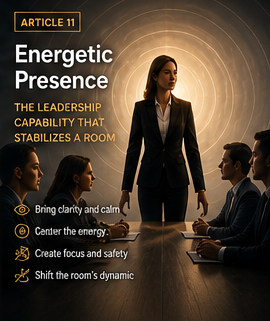 The Leadership Capability That Stabilizes a Room
Executive Scenario
Two leaders entered similar situations.
Both possessed strong expertise.
Both understood the strategy.
Both communicated effectively.
Yet their impact differed dramatically.
One increased tension.
The other created clarity.
One amplified uncertainty.
The other stabilized the environment.
The difference was not charisma.
It was presence.
Strategic Insight
Every leader influences the environment’s they enter.
People continuously assess:
- Confidence
- Clarity
- Congruence
- Stability
Energetic presence is not performance.
It is not personality.
It is the ability to stabilize, clarify, and shift a room through the way a leader enters and holds it.
Leaders with strong presence create conditions where:
- Complex conversations become manageable
- Uncertainty becomes navigable
- Decisions become clearer
- Teams regain confidence
Presence emerges when internal coherence aligns with external communication.
People respond not only to what leaders say.
They respond to the quality of attention leaders bring.
Practical Application
Observe how your presence affects others.
Ask:
- Does my communication create clarity or confusion?
- How do people behave after interacting with me?
- Do I amplify urgency or create focus?
- What emotional environment do I generate?
Presence begins with self-awareness.
Teams often mirror the state of leadership.
Case Study Example
A senior leadership team entered a critical planning session following several difficult quarters.
The room felt cautious.
Discussion remained surface-level.
Instead of pushing harder, the CEO slowed the conversation.
Questions became more precise.
Listening increased.
The emotional climate shifted.
Within an hour, the team surfaced issues that had remained unspoken for months.
The breakthrough came not from better analysis.
It came from a different leadership presence.
Reflection Questions
- What atmosphere do you create in high-pressure situations?
- How do others experience your leadership under stress?
- Where might greater steadiness improve team performance?
- What would change if you prioritized clarity over urgency?
Strategic Flow Activation
Strategic Flow Activation strengthens leadership presence by increasing coherence between thought, emotion, communication, and action.
My abilities enable me to activate this within you.
Because leaders do not simply influence outcomes.
They influence the environments where outcomes become possible.
The next capability builds on presence by transforming clarity into movement