
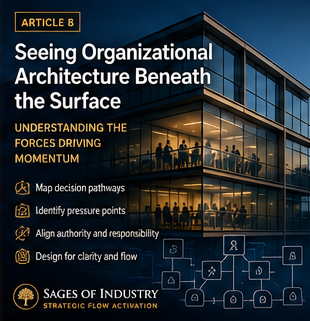
 Understanding the Forces Driving Momentum
Executive Scenario
A founder described their company as increasingly difficult to lead.
Meetings multiplied.
Decisions slowed.
Execution became inconsistent.
No single issue explained the problem.
The visible structure remained unchanged.
However, the organization’s underlying architecture had evolved.
Responsibility expanded.
Decision pathways became more complex.
Competing priorities intensified.
Leadership had outgrown the operating model without recognizing it.
Strategic Insight
Organizations are more than structures.
They are living systems shaped by:
- Incentives
- Pressure
- Relationships
- Timing
- Beliefs
- Resource flows
- Decision authority
These elements form the organization’s architecture.
This architecture determines:
- How information moves
- Where decisions slow
- Which behaviors emerge
- How innovation spreads
- Where resistance forms
Surface-level analysis often misses these dynamics because they exist beneath visible structures.
Advanced leaders develop the ability to perceive the deeper arrangement of forces influencing outcomes.
This is not intuition disconnected from evidence.
It is the disciplined observation of relationships, patterns, pressure points, and momentum.
Practical Application
Examine your organization through four questions:
- Where does information consistently slow?
- Which decisions require excessive effort?
- Where does responsibility exceed authority?
- Which tensions remain unresolved?
Look for recurring pressure points.
These reveal the architecture beneath the surface.
Case Study Example
A technology company experienced repeated delays despite significant investment in project management tools.
The visible issue appeared operational.
Deeper analysis revealed that decision authority had become unclear as the company scaled.
Teams escalated minor decisions.
Executives became bottlenecks.
Projects slowed.
No amount of process improvement could compensate for architectural misalignment.
Once decision rights became explicit, execution accelerated immediately.
The issue was not efficiency.
It was organizational design.
Reflection Questions
- Where does your organization consistently experience friction?
- What forces shape behavior beneath formal structures?
- Which decision pathways no longer support current complexity?
- What would change if you redesigned for clarity instead of control?
Strategic Flow Activation
Strategic Flow Activation helps leaders identify the hidden architecture influencing execution, innovation, and organizational momentum. My abilities enable me to activate this within you.
Because organizations do not move according to their intentions.
They move according to their underlying design.
Understanding that design creates the ability to change it.