
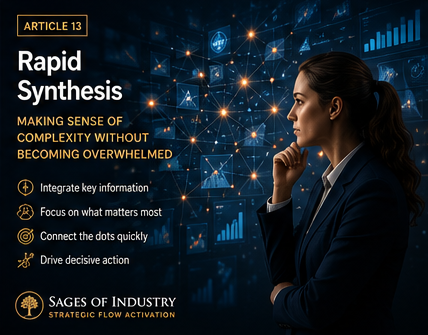
 Executive Scenario
An executive team faced an overwhelming amount of information.
Market changes accelerated.
Customer expectations evolved.
Internal priorities multiplied.
The challenge was not access to data.
It was making sense of it.
While competitors struggled to process complexity, one leader consistently identified the critical signals and acted decisively.
The difference was rapid synthesis.
Strategic Insight
Rapid synthesis is the ability to integrate multiple streams of information into a coherent understanding quickly.
It combines:
- Pattern recognition
- Systems awareness
- Emotional calibration
- Strategic foresight
Leaders with strong synthesis capabilities identify what matters most without becoming distracted by noise.
They connect seemingly unrelated signals.
They simplify complexity without oversimplifying reality.
This creates decisive action under pressure.
Practical Application
When complexity increases, ask:
- What information matters most?
- Which signals are connected?
- What assumptions can be removed?
- What is the central issue beneath the details?
Focus on relationships, not isolated data points.
Case Study Example
A company facing declining growth reviewed hundreds of data points.
Every department offered different explanations.
Rapid synthesis revealed a single underlying issue:
Customer expectations had evolved faster than internal decision-making.
Once leadership focused on the core constraint, execution accelerated.
Reflection Questions
- Where does complexity create hesitation?
- Which signals deserve greater attention?
- What patterns connect seemingly unrelated events?
- How quickly can you identify what matters most?
Strategic Flow Activation
Strategic Flow Activation helps leaders integrate complexity into clarity.
My abilities enable me to activate this within you.
Because organizations do not need more information.
They need better synthesis