
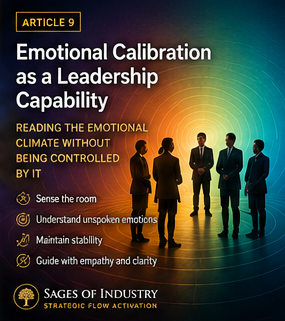
 Reading the Emotional Climate Without Being Controlled by It
Executive Scenario
A CEO entered a leadership meeting expecting a routine discussion.
The agenda appeared straightforward.
The metrics looked positive.
Yet something felt different.
Conversation was cautious.
Energy was low.
Questions remained unasked.
Despite strong performance indicators, the leadership team had become increasingly uncertain.
The CEO recognized that solving the visible agenda would not address the real issue.
The emotional climate had shifted.
And emotional climates shape outcomes.
Strategic Insight
Every team, organization, and market generates an emotional atmosphere.
Leaders influence that atmosphere whether they recognize it or not.
Emotional calibration is the ability to:
- Read the emotional tone of individuals and groups
- Understand underlying concerns
- Recognize shifts in confidence and trust
- Maintain stability under pressure
This capability differs from emotional contagion.
Effective leaders do not absorb the emotions around them.
They observe them.
They interpret them.
They respond intentionally.
Because emotional dynamics directly influence:
- Decision quality
- Risk tolerance
- Innovation
- Collaboration
- Execution speed
Organizations rarely stall because of logic alone.
They stall because emotional signals remain unrecognized.
Practical Application
Pay attention to:
- Changes in energy levels
- Repeated hesitation
- Unspoken tension
- Shifts in confidence
- Differences between stated agreement and observable behavior
Ask:
- What emotions are influencing decisions right now?
- What concerns remain unspoken?
- How is uncertainty affecting execution?
Emotional calibration begins with observation rather than reaction.
Case Study Example
A leadership team struggled to advance a major initiative despite strong strategic alignment.
The visible challenge appeared operational.
The deeper issue was emotional.
Previous failures had quietly reduced confidence.
Leaders avoided risk without explicitly discussing it.
Decision cycles expanded.
Innovation slowed.
Once leadership acknowledged and addressed the underlying emotional dynamics, execution accelerated significantly.
The strategy did not change.
The emotional climate did.
Reflection Questions
- What emotional dynamics influence your team today?
- Where does uncertainty remain unspoken?
- How do you respond when tension enters the room?
- Are you reacting to emotional signals or interpreting them?
Strategic Flow Activation
Strategic Flow Activation helps leaders strengthen emotional calibration so they can recognize shifts in confidence, trust, and momentum before performance declines. My abilities enable me to activate this within you.
Because leadership is not simply the management of strategy.
It is the management of energy, clarity, and collective movement.
The next step is learning how to recognize the atmosphere created by teams, markets, and industries before others can articulate what is changing.