
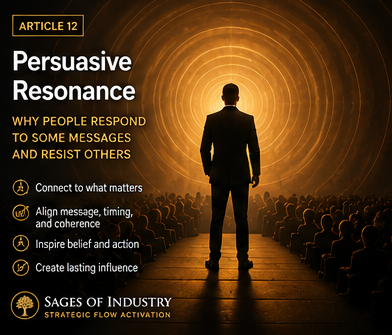
Executive Scenario
Two executives presented similar strategies.
Both used compelling data.
Both communicated clearly.
One inspired immediate action.
The other generated hesitation.
The difference was not information.
It was resonance.
People do not respond to information alone.
They respond when language, timing, and internal coherence align.
Strategic Insight
Persuasive resonance occurs when people do not simply understand a message—they feel its relevance and respond to it.
This capability combines:
- Clear thinking
- Emotional awareness
- Precise language
- Appropriate timing
- Internal coherence
Influence does not come from persuasion tactics.
It emerges when leaders communicate from a place of clarity strong enough to create alignment.
Resonance happens when people recognize that a message reflects their reality.
Practical Application
Before communicating important decisions, ask:
- What matters most to this audience?
- What concerns remain unspoken?
- Why does this message matter now?
- Am I communicating from clarity or urgency?
Effective influence begins with understanding.
Case Study Example
A board struggled to gain support for a major transformation initiative.
Initial presentations emphasized financial projections.
Resistance remained high.
Leadership shifted the conversation.
Instead of focusing only on outcomes, they addressed the underlying concerns shaping stakeholder perspectives.
Support increased rapidly.
The strategy did not change.
The resonance did.
Reflection Questions
- Which messages consistently create action?
- Where does communication break down?
- Are you speaking to data or deeper concerns?
- How does timing influence your effectiveness?
Strategic Flow Activation
Strategic Flow Activation strengthens persuasive resonance by aligning perception, communication, and timing.
My abilities enable me to activate this within you.
Because influence happens when people experience coherence—not just information.